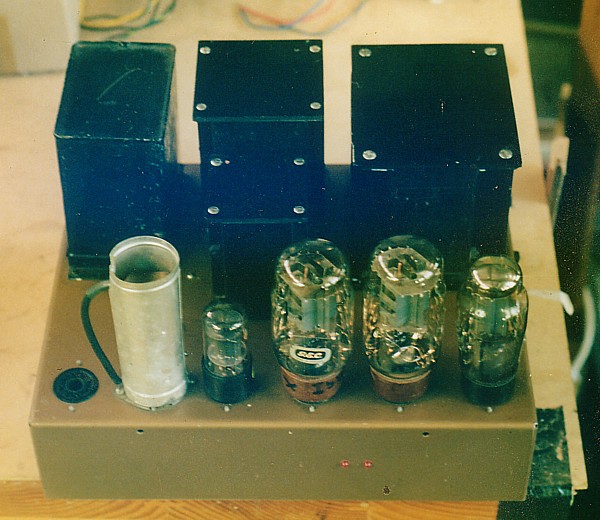
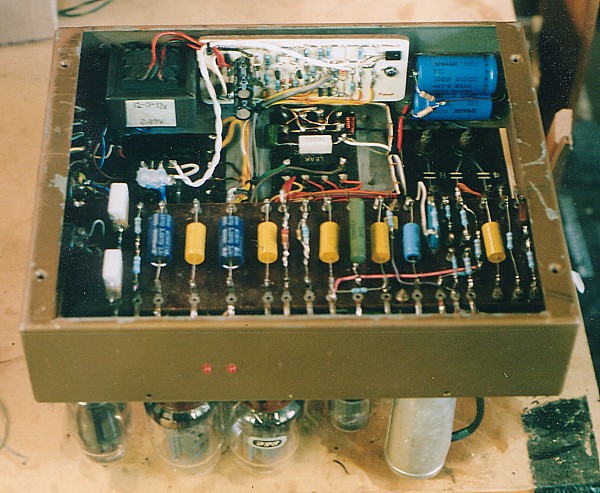
There is an additional 7VA auxiliary power transformer to the rear left, and additional filter caps on the
rear right.
Fig 3. The 1954 original schematic of Leak TL12 mono bloc amp, which I re-drew in Feb 2006...
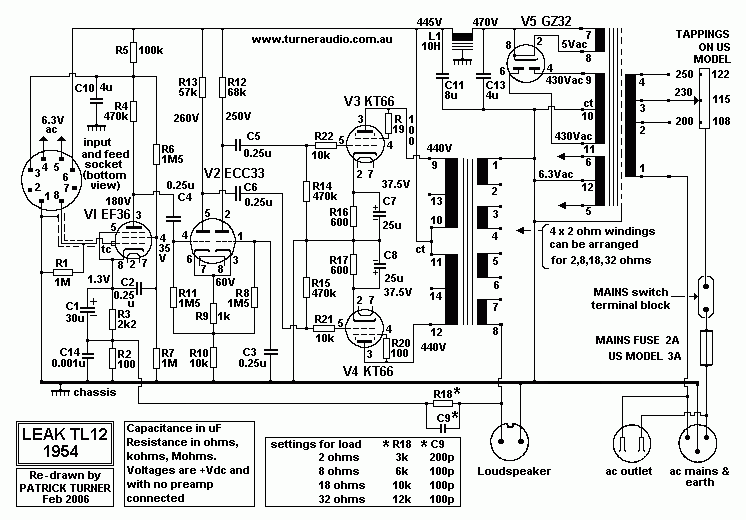
All the digital file copies I had of the original schematic from the Net were unreadable on the screen and
useless if printed. My own original 1954 paper copy became unreadable if anyone tried to copy it, mainly
because Leak refrained from using large clear lettering on their information sheets. I can only suppose that
Britain was still rather short of ink after WW2, or that British bean counters restricted the size of their lettering
since small letters are cheaper to have printed than large ones. So I red-drafted the original schematic as
exactly as I could so you can read it and it may print out OK. This was during the learning process with
MS Paint, which is what I now use to prepare schematics. The original schematic was a little too simple
for my liking, since this amp was not unconditionally stable. Modern people now expect all amplifiers to never
oscillate or behave badly.
Fig 4. Here is the Reformed leak TL12 schematic......
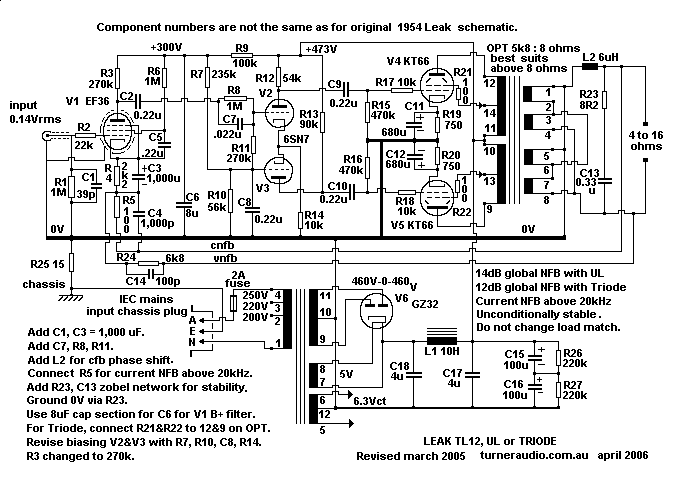
The above schematic has all the listed mods noted on the schematic. The numbers I have used for
components are not the same as in the 1954 original schematic. The improvements made this Leak amp
unconditionally stable and completely unlikely to oscillate at any frequency under any load condition, or
when turned on without any load connected. The amp can have the KT66 either Ultralinear or Triode
connected without changing the NFB arrangements.
Fig 5.
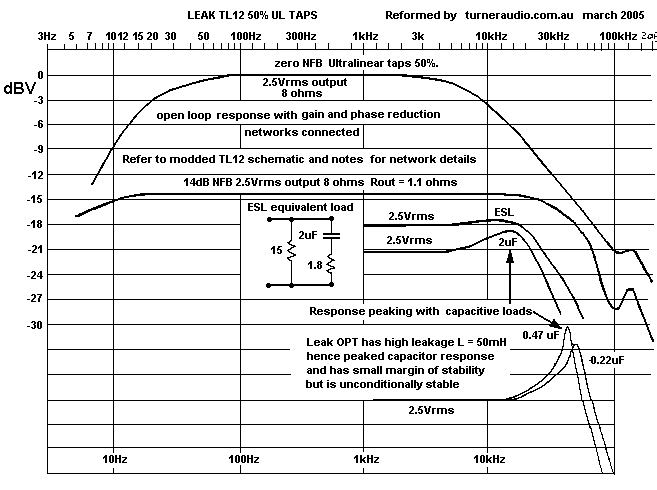
The above graph shows the effect of applied NFB on the amp. The HF response is shown with various
capacitance values used for a load along with the equivalent load which mimics Quad's ESL57. Notice the
peaking in the sine wave response above 20kHz with capacitance loadings. This shows that the amp is
barely able to remain stable. Any square wave will also have considerable over shoot and ringing
cycles before settling with capacitor loads. But with all the new networks used in new schematic I managed
to make the the margin of stability sufficient and the amp will NOT oscillate at HF like it surely does with
the original 1954 schematic. The 1954 amp also oscillated at LF without a load but the rearrangement of
the RC values between V1, and V2&V3 in my 2005 schematic stopped that problem.
Fig 6.
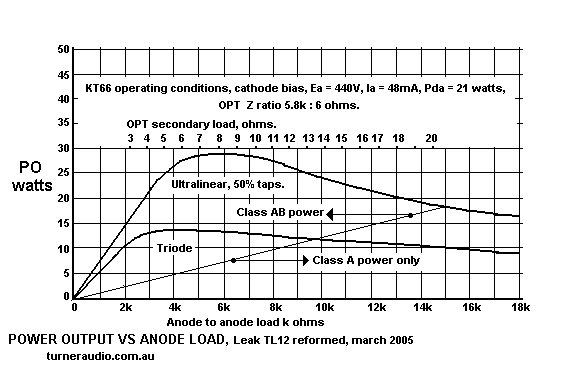
KT66 cathode resistances were increased from the 1954 original 600 ohms to 750 ohms to reduce
the idle Ia to about 48mA because I found that I had a higher B+ than in the original amp.
The dissipated power in each KT66 is still only 21W approximately, for 42W total and the class A
maximum power is thus about 17W in UL into 20r0 load and for triode the pure class A maximum is about
12W. For UL, at 8 ohms only 7W of class A is available with the remaining 20W in class AB.
There is also only 7W of class A into 8r0, and with the remaining 7W in class AB.
The amp as set up with secondaries wired as shown was meant for a customer who said he had a 16r0
speaker. For 16r0 there is 11W of pure class A in triode or 22W AB with including 14W of class A.
The triode instantaneous AB1 maximum is 15W into 5 ohms but with continuous sine wave it is 13W.
The use of loads less than 8 ohms isn't recommended. These figures should not mean much unless you have
speakers rated for only 85dB/W/M and you like huge levels. Most people would find these amps to sound
very well with moderate levels and speakers above 90dB/W/M sensitivity and above 8r0. About 7 years
ago I did a similar modification to a pair of TL12 and my client and I tried one amp in triode, and one in
ultralinear using a good source and fairly sensitive 15" dual concentric 1969 Tannoy speakers. Not the slightest
change in sound could be detected between triode or ultralinear, and more tests since confirmed that I can safely
conclude that either modes of output tube operation makes not the slightest difference in sound quality;
either way its excellent, well detailed, smooth, dynamic, creamy, warm and never dull, frumpish, or euphonic.
The pair of leaks I altered 7 years ago eventually wore out their motley collection of 40 year old aged KT66
and the owner had me change the KT66 for Sovtek 6550 which I wired in triode. The triode connection of either
6550, KT88, or KT90 gives about the same class AB output power as the KT66 in UL, and may be plugged
into the KT66 sockets without any circuit alterations.
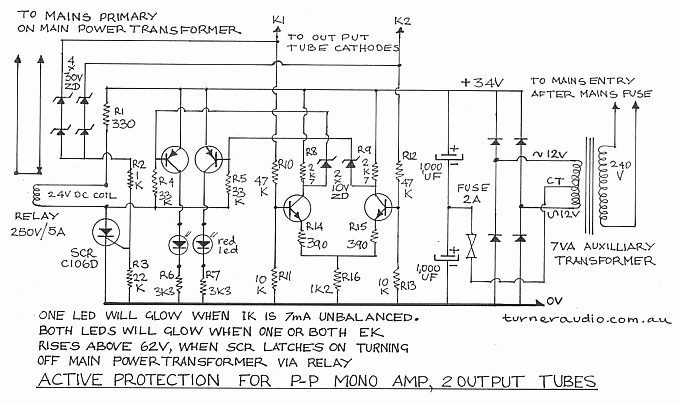
The leak TL12 OPTs are very fragile, with very thin wire in the 4,000 primary turns and hence my use of an
active protection circuit board to warn an owner of bias balance problems.
Fig 7.
To Re-engineered amps
To Index Page